
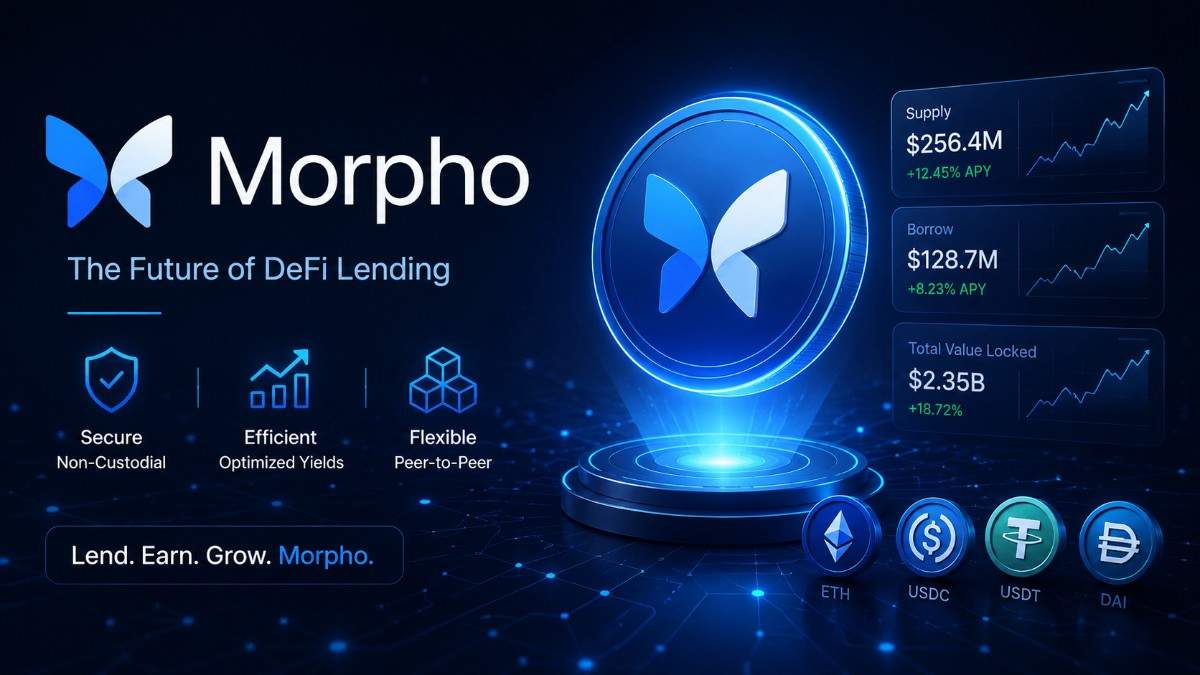
Standard Chartered has set a $60 price target for the DeFi protocol Morpho by 2030—representing a roughly 33-fold increase from current levels. Discover the full story behind this, the risks involved, and my personal take.
Over the past five years, I have read dozens of crypto reports from banks, but this latest one from Standard Chartered felt different. The reason is simple: it isn’t discussing a hyped-up meme coin, but rather a DeFi lending protocol that the average investor likely hasn’t even heard of yet.
Geoff Kendrick, the bank’s Head of Digital Assets Research, has set a target of $60 for the Morpho (MORPHO) token by 2030. Immediately following the report’s release, the token surged over 13% in a single day, pushing its price past the $2 mark. From current levels, this target implies a return of approximately 2,787%—or a roughly 33-fold gain.
Year-by-Year Targets: The Bank Reveals a Full Roadmap
This isn’t just a flat prediction. Kendrick has provided specific figures for each year: $3.50 by the end of 2026, $11 in 2027, $22 in 2028, $40 in 2029, and finally $60 in 2030. This gradual trajectory suggests the bank views this not as a sudden windfall, but as a story of the progressive maturation of tokenization.
Interestingly, Morpho isn’t the only name on the list. Just a few weeks ago, Standard Chartered set a $3,500 target for Aave by 2030—anticipating a surge of nearly 50 times its value. Previously, an upside of nearly 34x was projected for Uniswap as well. Clearly, the bank isn’t betting on just a single token—this represents a broad bullish thesis for the entire DeFi lending and infrastructure sector.
What exactly does Morpho do?
Let’s discuss what this protocol actually is. Simply put, Morpho is a decentralized lending platform, but its architecture is split into two components. The first—Morpho Markets—operates like a traditional lending market, currently holding around $5.5 billion in deposits. The second—Morpho Vaults—manages approximately $4.3 billion and is the area attracting interest from major institutional players. Overall, the protocol’s Total Value Locked (TVL) has reached nearly $9.8 billion, making it the second-largest DeFi lending platform after Aave.
Another noteworthy point is that Morpho currently operates with zero protocol fees, meaning all interest income goes directly to the depositors. This strategy differs from platforms like Uniswap and Aave, which have already implemented fee models. While this might currently look like a cost incurred for the sake of growth, monetizing the platform in the long run will be the ultimate test of the bank’s thesis.
Morpho also appears strong on the funding front. It recently closed a $175 million funding round featuring major names like Paradigm, a16z crypto, and VanEck, pushing the protocol’s valuation to around $2 billion. Custody platforms such as Fireblocks, Anchorage, and Taurus have also integrated Morpho Vaults into their systems, making it more accessible to institutional investors. Why Tokenization is
Considered a True Game-Changer
Standard Chartered’s entire argument rests on a major projection—the bank believes that total DeFi assets could grow 37-fold by 2030. If real-world assets like government bonds, real estate, or stablecoins migrate to the blockchain on a large scale, lending and management protocols—such as Morpho—stand to benefit directly.
For comparison, a similar pattern emerged during the “DeFi Summer” of 2020–21, when protocols like Compound and Aave saw their Total Value Locked (TVL) multiply within just a few months. The key difference is that, back then, most of the capital came from retail speculation, whereas the current narrative centers on institutional capital and real-world assets—a shift that could prove more sustainable, provided regulatory clarity is maintained.
My Personal Take: Promising, but Don’t Trust Blindly
Having covered this market for five years, I’ve learned one thing: banks’ long-term targets are often based on “best-case” scenarios rather than “worst-case” ones. In my view, Morpho’s business model is genuinely robust—featuring dual revenue streams, major custody partners, and institutional trust. This sets it apart from purely speculative tokens.
However, while the 33x figure is certainly alluring, achieving it in reality is equally challenging. It requires a convergence of three factors: 37-fold DeFi growth, rapid regulatory clarity, and an absence of major hacks or smart contract failures. Even a minor setback could derail the entire timeline. All in all, I view this news as moderately bullish in the short term (attracting institutional attention is a positive sign), but treating the 2030 target as a guarantee would be risky.
Read Also: Increased Scrutiny of Crypto in India: Parliamentary Report Labels Sector ‘High-Risk’
